
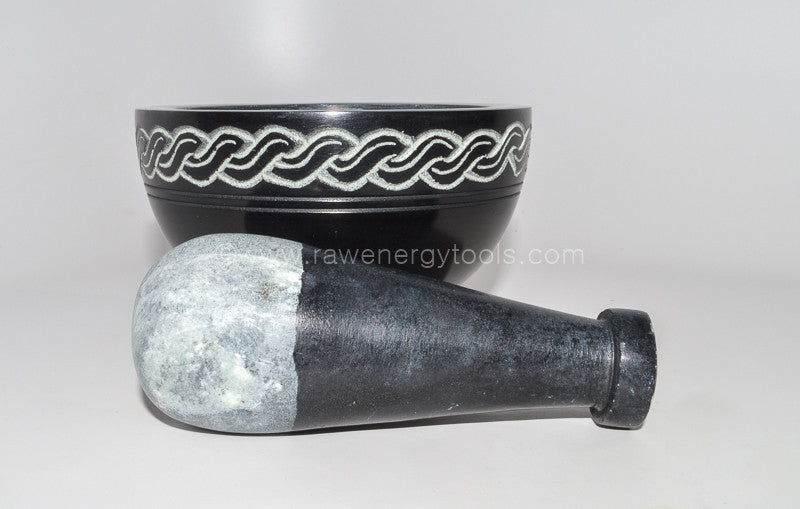
There are certain tools humans invent, use for a while, and eventually replace with something newer, faster, and shinier. And then there is the mortar and pestle. Apparently, humanity looked at a bowl and a heavy stick thousands of years ago and collectively decided:
Yep. Nailed it. No further improvements necessary. 😂
And honestly? We weren't wrong.
Mortars and pestles have been used across cultures and throughout history to crush plants, prepare food, grind medicines, pulverize pigments, blend herbs, and prepare materials for spiritual and ritual practices.
Today you can find them in kitchens, pharmacies, herbalists' workspaces, laboratories, and sitting beside crystals and herbs on people's altars. But their story started a LONG time before any of those things.
So...who invented the mortar and pestle?
That's where things get interesting. There isn't really one inventor. The basic idea of using one hard surface against another to crush and grind materials is ancient, and versions of grinding and pounding tools developed across different parts of the world.
Archaeological research from the Levant shows mortars and pestles being used thousands of years ago as people processed plant materials, including during the long transition toward agricultural communities. Other archaeological evidence shows grinding technology being used even earlier by hunter-gatherers.
In other words, the mortar and pestle isn't just old.
The basic technology behind it predates your kitchen, your pharmacy, your local herb shop, and quite possibly civilization as you normally think about it.
And the reason it survived is wonderfully simple: It works.
Ancient people had things to grind too
Imagine having dried seeds, tough plant material, roots, grains, minerals, pigments, or medicinal ingredients... and no blender. No food processor. No coffee grinder. No cute little electric herb grinder from Amazon.
You've got a rock. Congratulations. 😂
But crushing and grinding completely changes what can be done with raw materials. Seeds and grains can become flour. Dried plants can become powders. Minerals can become pigments. Multiple ingredients can be blended far more thoroughly than by hand.
The concept is incredibly simple, but it gave humans an entirely new way to transform the materials around them.
Then medicine got involved
This is where the mortar and pestle really earned its place in history. As medicinal preparations became more sophisticated, ingredients needed to be pulverized, combined, and prepared consistently. Mortars and pestles became indispensable equipment in the apothecary.
The Smithsonian's National Museum of American History describes the mortar as arguably the oldest pharmaceutical equipment and notes that apothecaries kept multiple mortars in different sizes and materials for different jobs. Larger ones could handle bulk materials while smaller ones were used for finer powders.
Think about that for a second. The little tool we now use to grind herbs or ritual salts was once essentially a piece of professional medical equipment. And it became so closely associated with preparing medicine that the mortar and pestle eventually became a symbol of pharmacy itself.
Some of them were GORGEOUS
Humans being humans, we apparently couldn't leave our useful little bowl alone. We had to decorate it. Historical European mortars were made from bronze, brass, marble, wood, glass, stone, and eventually porcelain. Some surviving examples are covered in flowers, geometric patterns, inscriptions, heraldic shields, people, animals and insects.
The Smithsonian collection includes surviving European mortars dating back centuries, including an ornate cast example from 1474 and another from 1477 decorated with vines, Gothic lettering, and even an alchemical symbol.
So if you've ever bought a mortar and pestle partly because you thought: “Okay, but this one is PRETTY.” You're participating in a surprisingly old tradition. 😂
The materials changed too
Stone wasn't the only option. Mortars have been made from wood, bronze, brass, glass, marble, porcelain, and other materials depending on the culture, time period, and intended use. And material actually mattered.
By the late 1700s, concerns about the toxicity of some metals helped push pharmacy away from mortars made with materials such as lead, tin, and early pewter compositions. Glass, porcelain, marble and stone became increasingly important alternatives.
Porcelain mortars became especially significant in pharmacy. The Smithsonian notes the introduction of porcelain mortars by Josiah Wedgwood in 1779 as part of the shift away from the massive decorative bronze mortars that had been used for centuries.
Which brings us right back to the innocent little white ceramic mortar and pestle I have. Its design may look incredibly simple. Its ancestry is not.
So why use one today?
Because after all these centuries, the basic mechanics still work beautifully. A mortar and pestle lets you control texture in a way an electric grinder often doesn't. You can lightly crack something. Crush it. Grind it into a finer powder. Blend several dry ingredients together. And you can actually see, smell, and feel what you're working with as it changes.
For herbal and spiritual work, that slower process can also be part of the appeal. You're not throwing ingredients into a machine, hitting a button, and walking away. You're physically working with them. For some people that's simply practical. For others, the process itself becomes intentional.
What can you use one for?
Today, mortar and pestle sets can be used for things like dried herbs and spices, ritual salts, loose incense ingredients, resins, and other dry materials. Different materials and surfaces behave differently, so the right mortar depends partly on what you're grinding.
Here's one rule worth remembering: If you're using a mortar and pestle for non-edible materials, don't turn around and use the same one for tonight's dinner.
Keep separate sets for food preparation and non-food materials. Nobody needs a little mystery incense resin seasoning in the guacamole. 😂
A ridiculously simple tool with a ridiculously long life
That's probably my favorite thing about the mortar and pestle.
- It isn't complicated.
- There aren't any moving parts.
- There isn't anything to plug in.
- There's no app.
- No firmware update.
- No subscription.
It's essentially two objects designed to crush something between them. And humans have found that useful for an extraordinarily long time.
From ancient plant processing to medicine and apothecaries, from kitchens to herbal workspaces, the mortar and pestle kept finding a place because the fundamental job never disappeared.
We still have things we want to crush. We still have ingredients we want to blend. And apparently after thousands of years... we still haven't found a particularly good reason to retire the bowl and stick.