
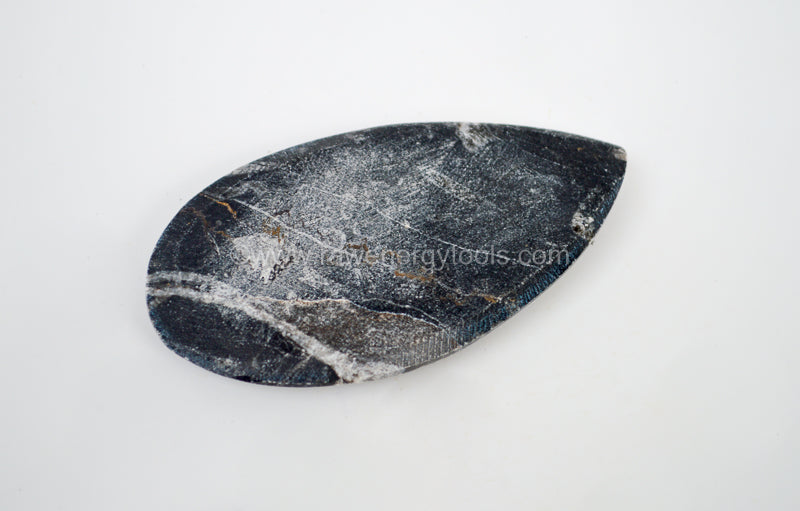
If you have ever walked through a crystal shop, you have probably seen one. A long, pale shape suspended inside polished black stone, sometimes carved into a sphere, bowl, slab, egg, or even an entire tabletop. It is usually labeled Orthoceras, but what exactly are you looking at? Because that white shape is not simply an interesting mineral pattern. It was once part of a living animal swimming through an ancient ocean hundreds of millions of years ago.
WHAT WAS ORTHOCERAS?
The fossils commonly sold today under the name Orthoceras belonged to extinct straight-shelled cephalopods. Cephalopods are mollusks, and the group includes modern animals such as octopuses, squid, cuttlefish, and nautiluses. Nautiloids represent one of the major branches of the cephalopod family tree, with an enormous variety of extinct relatives preserved in the fossil record.
The Moroccan fossils commonly marketed as Orthoceras are generally straight-shelled nautiloid cephalopods from the Paleozoic Era. Many of the familiar Moroccan specimens are Devonian in age, dating back roughly 370 million years. For a little perspective, dinosaurs would not appear for well over another hundred million years.
THAT LONG WHITE SHAPE WAS A SHELL
One of the most recognizable features of an Orthoceras fossil is the long structure divided into visible sections. Those sections were chambers within the animal's shell. The living animal occupied the open end, while the chambered portion of the shell played an important role in buoyancy. Chambered shells became an incredibly successful feature among ancient cephalopods and can also be seen in ammonites and living nautiluses.
After these animals died, their shells could settle onto the seafloor and become buried beneath sediment. Under the right conditions, the remains were preserved as the surrounding sediments eventually hardened into rock. What we see today is therefore not simply an attractive black and white stone. It is part of the geological record of an animal that lived hundreds of millions of years before humans existed.
WHY ARE SO MANY ORTHOCERAS FOSSILS BLACK AND WHITE?
The dramatic black and white appearance we commonly associate with polished Orthoceras pieces is especially familiar in fossil-bearing material from Morocco. When the surrounding rock is cut and polished, the fossilized shells and their internal structures become much easier to see. This material is frequently fashioned into eggs, spheres, bowls, bookends, slabs, jewelry, and other decorative pieces.
The important part is that polishing does not create those beautiful fossil patterns. It reveals what was already preserved inside the rock. Something that may have looked relatively ordinary before being cut can contain evidence of animals and ecosystems unimaginably older than anything in our everyday world.
IS IT REALLY ORTHOCERAS?
Here is where we tumble down a fun little fossil rabbit hole. Not every fossil sold commercially as Orthoceras is technically from the genus Orthoceras. The name has become widely used in the fossil and mineral trade for several kinds of straight-shelled fossil cephalopods. Moroccan material marketed under the Orthoceras name can represent other genera, and determining the precise identification can require much closer paleontological examination.
That does not make the specimens any less fascinating or somehow make them fake fossils. They are genuine remains of ancient marine animals. It simply means that the familiar name we see in crystal and fossil shops is sometimes being used more broadly than its strict scientific classification.
THE DEVONIAN WORLD
The Devonian Period lasted from approximately 419 to 359 million years ago and was an extraordinary chapter in Earth's history. Marine ecosystems were thriving and changing, fish underwent enormous diversification, and reefs supported complex communities of marine organisms. At the same time, life on land was undergoing major evolutionary changes of its own.
That is what makes the age of these fossils so difficult to wrap your head around. When the creature preserved inside an Orthoceras specimen was alive, Earth looked profoundly different from the planet we know today. Holding one means holding physical evidence from an environment that disappeared hundreds of millions of years before any human being ever walked the Earth.
ORTHOCERAS IN METAPHYSICAL TRADITIONS
Because fossils are preserved evidence of ancient life, modern metaphysical traditions often associate them with time, transformation, grounding, ancestry, endurance, and connection with Earth's history. Orthoceras is commonly used symbolically for personal growth, perspective, ancient wisdom, grounding, transformation, and moving forward while still honoring the past. These are traditional spiritual and metaphysical associations rather than scientifically established properties of the fossil.
There is something rather fitting about using a fossil as a symbol of transformation, though. It began as a living animal in an ancient sea, became buried beneath layers of sediment, survived hundreds of millions of years of geological change, and was eventually uncovered again. Today, we can hold evidence of that animal in our hands.
MORE THAN A DECORATIVE STONE
Perhaps that is what makes fossils so different from many of the other pieces we keep in our collections. Crystals and minerals can tell us incredible stories about geology and how our planet formed and changed, while fossils add another piece to that story. They show us the life that existed within those ancient environments.
That pale shape running through a piece of polished Orthoceras is evidence that an animal once lived in an ocean on an Earth we would barely recognize today. Hundreds of millions of years later, a small part of its existence remains preserved in stone. And honestly, once you know what you are actually looking at, that little black-and-white fossil suddenly becomes a whole lot more interesting. 💜