
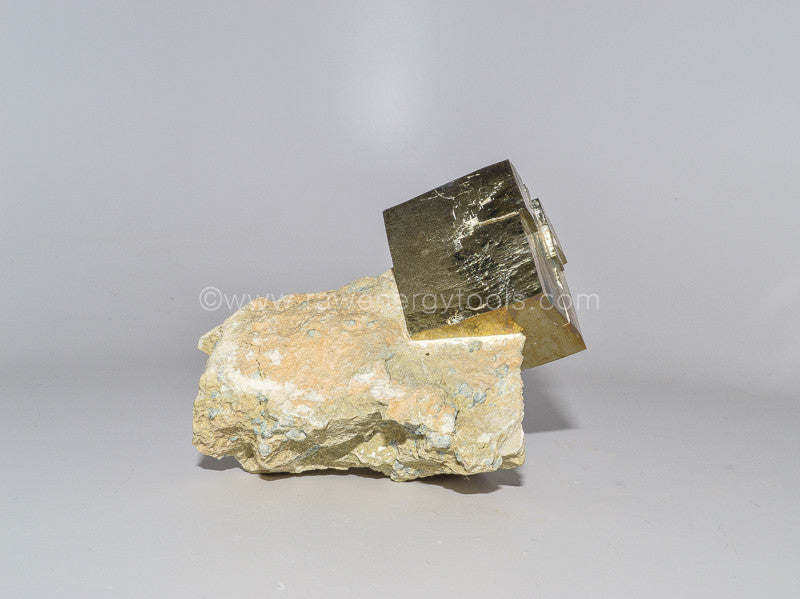
Pick up a piece of Quartz and turn it beneath the light. Now do the same with Tiger’s Eye, Pyrite, or a piece of Chalcedony. They may all reflect light, but they do not reflect it in quite the same way. One might look glassy, another metallic, another silky, and another almost waxy.
There is actually a geological term for this: luster.
Luster describes the way light interacts with and reflects from the surface of a mineral. It is one of the characteristics mineralogists use when observing and identifying minerals, along with properties such as hardness, color, streak, cleavage, and crystal structure.
And once you know what you are looking for, luster becomes one of those things you start noticing everywhere.
LUSTER IS NOT JUST ABOUT BEING SHINY
It is easy to think luster simply means how shiny a crystal is, but there is more to it than that. Two minerals can both reflect plenty of light while looking completely different from one another.
Think about the difference between looking at a piece of glass and looking at polished metal. Both can shine, but the quality of that reflected light is completely different.
That difference is what luster attempts to describe.
Minerals are generally first divided into two broad categories: metallic and nonmetallic luster. From there, nonmetallic minerals may be described using more specific terms such as vitreous, pearly, silky, waxy, resinous, or adamantine.
METALLIC LUSTER
A mineral with metallic luster reflects light in a way that resembles polished metal. These minerals are usually opaque and can have a strong, reflective appearance.
Pyrite is probably one of the most recognizable examples. Its bright metallic surface and golden color are responsible for the famous nickname “Fool’s Gold.” Galena is another classic example, displaying a bright metallic gray appearance.
Metallic luster can make a mineral look almost manufactured, even though that reflective surface was created entirely through natural geological processes.
VITREOUS LUSTER
Vitreous means glasslike, and this is one of the most common types of luster seen in minerals.
Quartz is a familiar example. Whether you are looking at Clear Quartz, Amethyst, Citrine, or Smoky Quartz, the mineral often reflects light with a glassy appearance.
Many crystals sold in metaphysical shops have vitreous luster, which may be one reason we so naturally associate crystals with sparkling, glasslike surfaces.
PEARLY LUSTER
Some minerals reflect light with a soft glow reminiscent of the surface of a pearl. This is known as pearly luster.
Rather than producing the sharp reflection we might see from glass or metal, pearly surfaces often appear softer and more luminous. This effect can occur when light interacts with thin layers or cleavage surfaces within a mineral.
Some feldspars and other layered minerals may display pearly luster on particular surfaces.
SILKY LUSTER
This one should sound very familiar after our recent Tiger’s Eye adventure. 😂
Silky luster occurs when a mineral contains very fine parallel fibers or structures that interact with light. Instead of simply reflecting from one smooth surface, the light appears to move across those aligned structures.
Tiger’s Eye is a beautiful example. Its fibrous structure produces the glowing band of light known as chatoyancy, creating the familiar cat’s eye effect that seems to move as the stone turns.
This is why Tiger’s Eye can look almost alive beneath changing light.
WAXY LUSTER
Some minerals have a surface that appears almost as though it has been coated with a thin layer of wax. Appropriately enough, this is called waxy luster.
Certain varieties of Chalcedony can display this softer appearance. Instead of looking sharply glassy or highly reflective, the surface may seem smooth, slightly muted, and waxlike.
It is a good reminder that a mineral does not need to sparkle dramatically to have an interesting relationship with light.
ADAMANTINE LUSTER
At the other end of the spectrum is adamantine luster, an exceptionally brilliant type of reflection.
Diamond is the most famous example. Its very high refractive index contributes to the intense brilliance associated with cut diamonds. Some other minerals can also be described as adamantine or subadamantine when they display an unusually bright, brilliant luster.
The word itself comes from an old term associated with extreme hardness or brilliance, which feels rather appropriate for Diamond.
DOES POLISHING CHANGE A MINERAL’S LUSTER?
This is where things get interesting for crystal collectors because many of the stones in our collections have been cut, shaped, or polished.
Polishing can absolutely change how clearly we see a mineral’s reflective qualities. A smooth surface generally reflects light differently than a rough, uneven one. That is why a polished sphere may appear dramatically shinier than a rough piece of the same material.
But polishing does not change the mineral into something else or create its underlying optical properties. The mineral’s composition, structure, and interaction with light are still responsible for the characteristics we observe.
Surface condition matters too. Weathering, tiny scratches, coatings, inclusions, and even the particular crystal face being observed can influence how luster appears.
So if your rough crystal does not look exactly like the beautifully polished version beside it, that does not necessarily mean one is “better.” You may simply be seeing the same mineral through two very different surfaces.
WHY DOES LUSTER MATTER?
Luster is more than a pretty description for a crystal listing. Along with other physical properties, it can help mineralogists narrow down the identity of an unknown specimen.
Color alone can be surprisingly unreliable because the same mineral may occur in several colors, while completely different minerals may share nearly identical coloring. Observing how a mineral reflects light gives us another clue.
For collectors, learning about luster also gives us another way to appreciate what we already own. Suddenly the difference between the metallic gleam of Pyrite, the glassy surface of Quartz, and the silky movement of Tiger’s Eye is not simply a matter of one crystal being shinier than another.
Each is interacting with light in its own way.
THE NEXT TIME YOU LOOK AT YOUR COLLECTION...
Pick up a few different minerals and move them beneath a light. Do not look at their colors first. Look at the quality of the reflection.
Does the surface remind you of glass? Metal? Silk? Wax? A pearl?
You may begin noticing details you have looked at hundreds of times without ever really seeing.
And that may be one of my favorite things about learning the geology behind crystals. Understanding why something looks the way it does does not make it any less beautiful.
Sometimes it makes you appreciate it even more. 💜
A THOUGHT TO CARRY WITH YOU
Sometimes beauty is not simply about what catches the light, but how uniquely something reflects it. 💜