
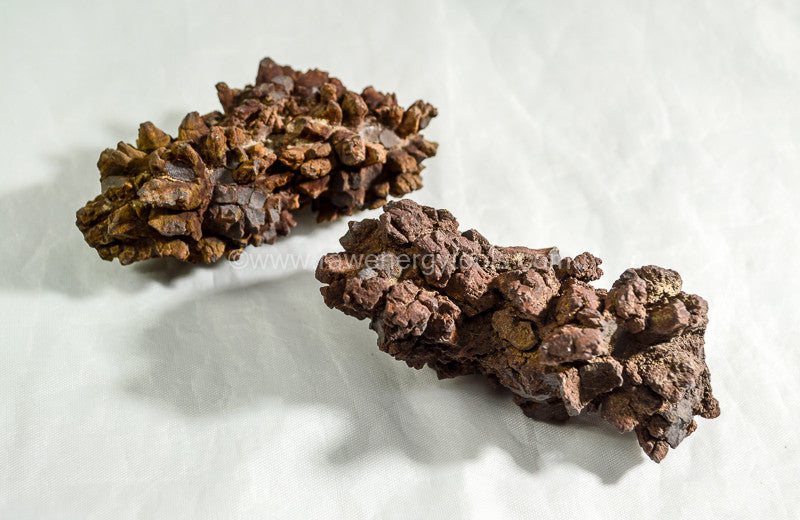
Of all the things that could survive millions of years, you probably wouldn't expect poop to make the list. Bones? Sure. Teeth? Absolutely. Shells, plants, and ancient footprints? Those make sense. But poop?
Believe it or not, fossilized poop is a real thing, and scientists are genuinely interested in studying it. Known as coprolite, this unusual type of fossil can reveal some pretty fascinating information about animals that lived long before humans ever appeared.
And yes, people actually collect it. I happen to be one of them!
WHAT EXACTLY IS COPROLITE?
Coprolite is the scientific name for fossilized feces. The word comes from the Greek words kopros, meaning dung, and lithos, meaning stone.
Unlike a fossilized bone or tooth, coprolite is considered a trace fossil. Trace fossils preserve evidence of an organism's activities rather than the physical remains of the organism itself. Footprints, burrows, and nests are other familiar examples.
Coprolites have been discovered from a variety of ancient animals, including fish, reptiles, mammals, and dinosaurs.
And before you ask, no, fossilized poop isn't the same as picking up fresh animal droppings. Over time, the original material can become preserved through mineralization, leaving behind a fossil that is very different from what it once was.
HOW DOES POOP BECOME A FOSSIL?
Most animal waste decomposes fairly quickly, so for poop to survive long enough to become fossilized, the conditions have to be just right.
Rapid burial in sediment can help protect the material from being scattered, consumed, or broken down. Under favorable conditions, minerals may gradually preserve its structure.
Over immense periods of time, the material can become part of the geological record.
Not all fossilized dung forms in the same way, and preservation depends on the surrounding environment. Some coprolites retain recognizable shapes, while others contain tiny fragments of material from the animal's last meals.
Which brings us to the part scientists find particularly interesting.
WHAT CAN SCIENTISTS LEARN FROM ANCIENT POOP?
You might be surprised how much information can be hidden inside something an animal left behind millions of years ago.
Depending on how well a coprolite is preserved, paleontologists may discover fragments of bone, fish scales, shells, plant material, and other remains. These little clues can help researchers understand what ancient animals were eating and how they interacted with their environments.
For example, a coprolite containing fragments of bone may suggest that its producer ate other animals. Plant material may provide clues about herbivorous diets.
Coprolites can also help researchers investigate ancient food chains and sometimes even where animals were living.
Of course, identifying exactly which animal produced a particular fossil isn't always easy. Scientists examine its shape, size, contents, age, and geological surroundings to narrow down the possibilities.
Apparently, even millions of years later, figuring out who left the poop behind can still be a challenge.
SOME PREHISTORIC POOP FACTS YOU PROBABLY DIDN'T KNOW
💜 Coprolites come in all shapes and sizes. Some are tiny, while others are surprisingly large. Their appearance can vary dramatically depending on the animal and the conditions under which they were preserved.
💜 Not all coprolites are dinosaur poop. Fossilized dung has been discovered from many different types of animals, including ancient fish, reptiles, and mammals.
💜 Coprolites can contain evidence of ancient meals. Bone fragments, scales, and plant remains may survive within the fossil, offering clues about what the animal had eaten.
💜 Scientists have studied fossilized poop for nearly 200 years. The geologist William Buckland helped establish the scientific study of coprolites during the nineteenth century.
💜 Ancient poop can tell us about entire ecosystems. These fossils sometimes reveal information about feeding relationships that would be difficult to determine from skeletons alone.
One of my favorite things about paleontology is that even the strangest discoveries can teach us something important about Earth's history.
A LITTLE POOP STORY FROM RAW ENERGY TOOLS
I've had a rather unusual coprolite specimen in my collection since 2012. Originally, I had two pieces, both acquired as fossilized turtle dung from Madagascar.
About seven years ago, I had a plumbing emergency at my house, and a wonderful plumber named Mr. Stafford came out to take care of the problem.
While he was there, he became fascinated with my crystals, minerals, and fossils. He was genuinely interested in everything, so naturally, I started showing him some of the more unusual pieces in my collection.
Eventually, I handed him a piece of coprolite. Imagine handing a plumber a piece of fossilized poop. It was fantastic, haha, and he was absolutely delighted with it, but in all his excitement, he accidentally dropped it. The poor fossil hit the floor and broke.
Mr. Stafford looked horrified. His eyes widened, and he exclaimed:
"OMG, I just broke your poop!"
I laughed so hard and assured him it was ok. He felt terrible, but I thought the whole thing was hilarious. I told him he could keep the broken fossil, and he went home with his very own piece of prehistoric poop.
Sadly, Mr. Stafford has since passed away, but I still remember him with a smile. He was such a wonderful person, and that ridiculous little moment is something I'll never forget.
I still have the other coprolite from my original pair, and every time I think about it, I remember the day a plumbing emergency turned into one of the funniest fossil-related experiences I've ever had.
Of all the things I expected a plumber to say in my house, "I just broke your poop" certainly wasn't one of them.
WHY COLLECT SOMETHING SO UNUSUAL?
Fossils give us an extraordinary opportunity to connect with life from the distant past. Most people naturally gravitate toward beautiful ammonites, impressive teeth, or detailed fossilized shells.
Coprolites are a little different.
They may not be glamorous, but they preserve evidence of something every animal has to do. They're reminders that prehistoric creatures weren't simply impressive skeletons waiting to become museum exhibits. They were living animals that ate, moved, interacted with their environments, and yes, went to the bathroom.
That makes coprolite a surprisingly personal connection to prehistoric life.
There's also something amusing about the fact that material once discarded by an ancient animal can eventually become scientifically valuable and collectible.
Nature certainly has a sense of humor.
A Thought to Carry With You
I think one of the most interesting things about fossils is that we never really know what will survive the passage of time. Something as ordinary as an animal's waste can become an important clue to understanding life millions of years ago.
And sometimes, the strangest objects end up carrying the best memories.
My little piece of coprolite may have started as ancient animal dung, but after all these years, it also reminds me of a wonderful gentleman named Mr. Stafford and a day that still makes me laugh.
I think that's part of what makes collecting natural history so enjoyable. Every specimen has a story, and occasionally, that story involves a plumber accidentally breaking your poop.
See Coprolite